Search “best foods for gut health” and you’ll get a wall of listicles recommending kombucha, bone broth, and whatever superfood is trending this month. Most of these lists are recycled from each other with no actual research cited.
Here’s what the evidence actually supports — and more importantly, why these foods help.
The gut health fundamentals
Before listing foods, it helps to understand what “gut health” means in measurable terms. Researchers typically assess it through three factors:
- Microbiome diversity — a wider variety of bacterial species is consistently associated with better health outcomes1
- Barrier integrity — a well-functioning intestinal lining that keeps bacteria and toxins out of the bloodstream
- Low inflammation — minimal chronic immune activation in the gut wall
Every food on this list supports at least one of these, with clinical evidence behind it.
Fiber-rich foods: the foundation
If there’s one dietary factor with the most consistent evidence for gut health, it’s fiber. Not a supplement — actual fiber from whole foods.
The American Gut Project — the largest citizen science microbiome study ever conducted — analyzed stool samples from over 10,000 participants and found that the single strongest predictor of a healthy gut microbiome was the number of different plant foods consumed per week. People who ate 30+ different plants per week had significantly more diverse microbiomes than those eating 10 or fewer.2
The mechanism is straightforward: different types of fiber feed different bacterial species. The more variety you eat, the more bacterial diversity you support.
Top fiber sources and what they feed
Legumes (lentils, chickpeas, black beans) — among the highest-fiber foods available. They contain both soluble fiber (which bacteria ferment into beneficial short-chain fatty acids) and resistant starch, which specifically feeds Bifidobacterium and Roseburia species.3
Whole grains (oats, barley, quinoa, brown rice) — rich in beta-glucans and arabinoxylan, which are fermented into butyrate. Butyrate is the preferred energy source of colon cells and plays a critical role in maintaining barrier integrity.4
Vegetables (especially onions, garlic, leeks, artichokes, asparagus) — these contain inulin and fructooligosaccharides (FOS), which are potent prebiotics that selectively feed beneficial Bifidobacteria.5
Fruit (berries, apples, bananas, kiwi) — provide pectin and polyphenols. Green kiwifruit has specific evidence for improving bowel regularity and gut microbiome composition.6
A caveat: if you currently eat a low-fiber diet, increasing fiber too quickly can cause gas and bloating. Increase gradually over 2-3 weeks to allow your microbiome to adapt.
Fermented foods: feeding and seeding
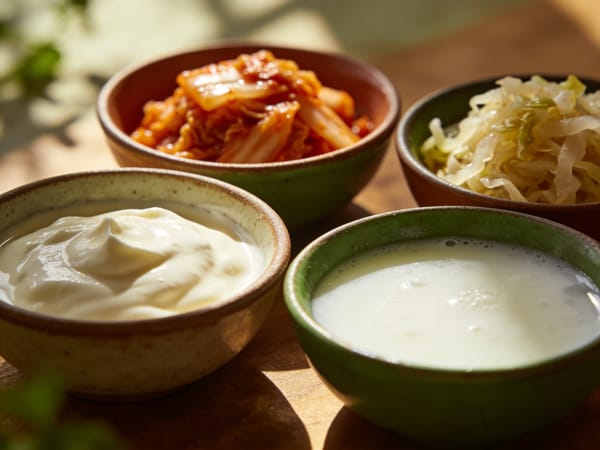
Fermented foods provide both live beneficial bacteria and the metabolites those bacteria produce during fermentation.
Wastyk et al. ran a landmark clinical trial at Stanford comparing a high-fermented-food diet to a high-fiber diet over 10 weeks. The fermented food group showed increased microbiome diversity and decreased inflammatory markers (including IL-6, IL-10, and IL-12b). The high-fiber group did not see the same diversity increase.7
This was a surprising finding. It suggests that fermented foods may be uniquely effective at increasing microbial diversity — even more so than fiber alone.
The strongest evidence
Yogurt (with live cultures) — one of the most studied fermented foods. Regular yogurt consumption is associated with increased Lactobacillus and Streptococcus thermophilus populations and reduced markers of gut inflammation.8
Kefir — contains a more diverse microbial community than yogurt (typically 30-50 species vs yogurt’s 2-3). Marco et al. reviewed the evidence and found that kefir consumption is associated with improved lactose digestion, antimicrobial activity, and modulation of the immune system.9
Sauerkraut and kimchi — naturally fermented vegetables provide both fiber and live Lactobacillus species. Kimchi has additional evidence for anti-inflammatory effects due to its combination of fermented vegetables, garlic, and ginger.10
Miso and tempeh — fermented soy products provide unique bacterial strains and are associated with reduced inflammatory markers in population studies.
The key qualifier: these must be naturally fermented and unpasteurized. Heat treatment (pasteurization) kills the live bacteria, which is why shelf-stable “fermented” products offer less benefit than refrigerated ones.
Polyphenol-rich foods: the underappreciated factor
Polyphenols are plant compounds that act as prebiotics — they’re poorly absorbed in the small intestine and reach the colon, where bacteria metabolize them into bioactive compounds.
Cardona et al. reviewed the evidence and found that dietary polyphenols significantly increase beneficial bacteria (especially Bifidobacterium and Lactobacillus) while inhibiting potentially harmful species.11
Top polyphenol sources
Berries (blueberries, raspberries, blackberries) — among the highest polyphenol concentrations of any food. Blueberry consumption has been shown to increase Bifidobacterium in human trials.12
Dark chocolate / cocoa — cocoa polyphenols are extensively metabolized by gut bacteria. Tzounis et al. showed that high-cocoa chocolate consumption increased Bifidobacterium and Lactobacillus populations while reducing Clostridia counts.13
Green tea — catechins in green tea have prebiotic effects and anti-inflammatory properties in the gut.
Extra virgin olive oil — a cornerstone of the Mediterranean diet. Its polyphenols have been shown to favorably modulate gut microbiome composition and reduce intestinal inflammation.14
Red wine (in moderation) — contains resveratrol and other polyphenols that benefit gut bacteria. However, alcohol itself damages the gut barrier, so the net benefit only applies to moderate consumption (1 glass).
Omega-3 rich foods: the inflammation fighters
Omega-3 fatty acids (EPA and DHA) have direct anti-inflammatory effects in the gut lining and have been shown to modulate microbiome composition.
Costantini et al. reviewed the evidence and found that omega-3 supplementation increases Bifidobacterium, Roseburia, and Lactobacillus while decreasing Faecalibacterium in some contexts. The anti-inflammatory effects are well-established.15
Fatty fish (salmon, mackerel, sardines) — the richest dietary source of EPA and DHA. Aim for 2-3 servings per week.
Walnuts — provide alpha-linolenic acid (ALA) and have specific evidence for increasing gut microbial diversity.
Flaxseeds and chia seeds — provide ALA plus soluble fiber, making them a two-in-one gut health food.
What to limit
The research also identifies foods that consistently harm gut health:
Ultra-processed foods — Zinöcker and Lindseth reviewed the evidence and concluded that ultra-processed foods promote gut dysbiosis through multiple mechanisms: low fiber content, high sugar and emulsifier content, and reduced microbial diversity.16
Artificial sweeteners — Suez et al. showed that saccharin, sucralose, and aspartame alter gut microbiome composition and can impair glucose tolerance — effects mediated entirely through the microbiome.17
Emulsifiers — common food additives like polysorbate 80 and carboxymethylcellulose damage the protective mucus layer of the gut, as demonstrated by Chassaing et al. in a widely cited Nature study.18
The practical framework
Rather than obsessing over specific superfoods, the research points to a simple framework:
- Eat 30+ different plant foods per week — variety matters more than any single food
- Include fermented foods daily — yogurt, kefir, sauerkraut, kimchi, or miso
- Prioritize whole foods over processed — the processing itself is often the problem
- Eat polyphenol-rich foods regularly — berries, dark chocolate, green tea, olive oil
- Get omega-3s from fatty fish 2-3 times per week
- Increase fiber gradually — too much too fast backfires
No single food will transform your gut health. But a consistent pattern of diverse, whole, fiber-rich, and fermented foods creates an environment where beneficial bacteria thrive and inflammation stays low. If you’re dealing with gut barrier issues specifically, this leaky gut diet guide covers a structured meal plan built around these same principles.
References
Valdes AM, Walter J, Segal E, Spector TD. “Role of the gut microbiota in nutrition and health.” BMJ, 2018; 361: k2179. PubMed ↩︎
McDonald D, Hyde E, Debelius JW, et al. “American Gut: an open platform for citizen science microbiome research.” mSystems, 2018; 3(3): e00031-18. PubMed ↩︎
Koh A, De Vadder F, Kovatcheva-Datchary P, Bäckhed F. “From dietary fiber to host physiology: short-chain fatty acids as key bacterial metabolites.” Cell, 2016; 165(6): 1332-1345. PubMed ↩︎
Rivière A, Selak M, Lantin D, et al. “Bifidobacteria and butyrate-producing colon bacteria: importance and strategies for their stimulation in the human gut.” Frontiers in Microbiology, 2016; 7: 979. PubMed ↩︎
Gibson GR, Hutkins R, Sanders ME, et al. “Expert consensus document: The International Scientific Association for Probiotics and Prebiotics (ISAPP) consensus statement on the definition and scope of prebiotics.” Nature Reviews Gastroenterology & Hepatology, 2017; 14(8): 491-502. PubMed ↩︎
Ansell J, Butts CA, Paturi G, et al. “Kiwifruit-derived supplements increase stool frequency in healthy adults: a randomized, double-blind, placebo-controlled study.” Nutrition Research, 2015; 35(5): 401-408. PubMed ↩︎
Wastyk HC, Fragiadakis GK, Perelman D, et al. “Gut-microbiota-targeted diets modulate human immune status.” Cell, 2021; 184(16): 4137-4153. PubMed ↩︎
Savaiano DA, Hutkins RW. “Yogurt, cultured fermented milk, and health: a systematic review.” Nutrition Reviews, 2021; 79(5): 599-614. PubMed ↩︎
Marco ML, Heeney D, Binda S, et al. “Health benefits of fermented foods: microbiota and beyond.” Current Opinion in Biotechnology, 2017; 44: 94-102. PubMed ↩︎
Park KY, Jeong JK, Lee YE, Daily JW. “Health benefits of kimchi (Korean fermented vegetables) as a probiotic food.” Journal of Medicinal Food, 2014; 17(1): 6-20. PubMed ↩︎
Cardona F, Andrés-Lacueva C, Tulipani S, et al. “Benefits of polyphenols on gut microbiota and implications in human health.” Journal of Nutritional Biochemistry, 2013; 24(8): 1415-1422. PubMed ↩︎
Vendrame S, Guglielmetti S, Riso P, et al. “Six-week consumption of a wild blueberry powder drink increases bifidobacteria in the human gut.” Journal of Agricultural and Food Chemistry, 2011; 59(24): 12815-12820. PubMed ↩︎
Tzounis X, Rodriguez-Mateos A, Vulevic J, et al. “Prebiotic evaluation of cocoa-derived flavanols in healthy humans by using a randomized, controlled, double-blind, crossover intervention study.” American Journal of Clinical Nutrition, 2011; 93(1): 62-72. PubMed ↩︎
Martín-Peláez S, Castañer O, Solà R, et al. “Influence of phenol-enriched olive oils on human intestinal immune function.” Nutrients, 2016; 8(4): 213. PubMed ↩︎
Costantini L, Molinari R, Farinon B, Merendino N. “Impact of omega-3 fatty acids on the gut microbiota.” International Journal of Molecular Sciences, 2017; 18(12): 2645. PubMed ↩︎
Zinöcker MK, Lindseth IA. “The Western diet-microbiome-host interaction and its role in metabolic disease.” Nutrients, 2018; 10(3): 365. PubMed ↩︎
Suez J, Korem T, Zeevi D, et al. “Artificial sweeteners induce glucose intolerance by altering the gut microbiota.” Nature, 2014; 514(7521): 181-186. PubMed ↩︎
Chassaing B, Koren O, Goodrich JK, et al. “Dietary emulsifiers impact the mouse gut microbiota promoting colitis and metabolic syndrome.” Nature, 2015; 519(7541): 92-96. PubMed ↩︎